
Millions of people are doing Dry January right now.
They’re cutting something they know isn’t helping—so they can feel better, work better, and stop pretending “I’ll start Monday” is a strategy.
Your business has a Dry January list too.
It’s just made of tech habits instead of cocktails.
You know the ones.
They’re risky. Inefficient. Annoying.
And everyone keeps doing them because “we’re busy” and “it’s fine.”
Until it’s not.
Here are six tech habits accounting firms should quit cold turkey—and what to do instead.
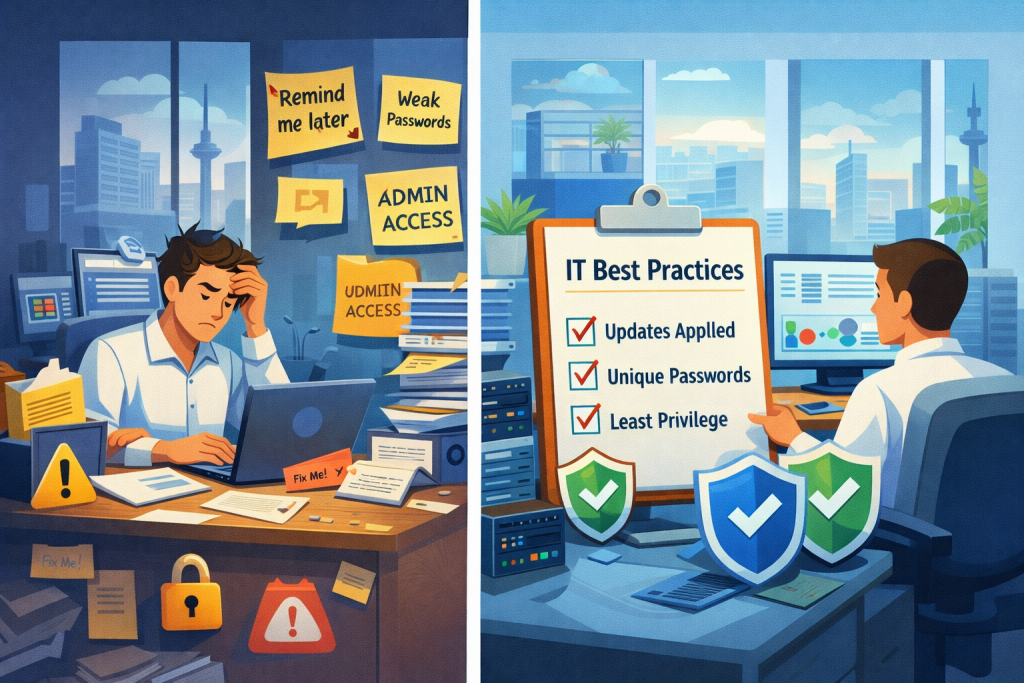
- Clicking “Remind Me Later” on Updates
That button has caused more damage than most hackers.
Updates don’t just add features—they patch security holes criminals are already exploiting. Every delay means you’re running software with known vulnerabilities.
That’s exactly how attacks like WannaCry spread so fast: patches existed, but people postponed them.
Quit it:
Schedule updates after hours or let your IT partner push them silently in the background. No surprise restarts. No open doors.
- Using One Password Everywhere
You’ve
got a “strong” password.
And you use it for email, banking, Microsoft 365, CRA portals, and that random vendor account from 2021.
Here’s the problem: breaches happen constantly. Hackers don’t guess passwords anymore—they reuse leaked ones. It’s called credential stuffing, and it works frighteningly well.
Quit it:
Use a password manager. One master password. Unique, complex passwords everywhere else. Setup takes minutes. Protection lasts indefinitely.
- Sharing Passwords Over Email or Text
“Can you send me the login?”
“Sure—here it is.”
That message now lives forever: inboxes, backups, cloud archives. If anyone’s account gets compromised, attackers can search for the word “password” and harvest credentials instantly.
Quit it:
Use secure password sharing inside a password manager. Access without exposure. Revocable anytime. No permanent paper trail.
- Making Everyone an Admin Because It’s Faster
Someone needed to install something once… and suddenly half the firm has admin rights.
Admin access means full control. If those credentials get phished, attackers don’t just get in—they get everything.
Quit it:
Use least-privilege access. People get exactly what they need and nothing more. Slightly slower today. Infinitely safer tomorrow.
- “Temporary” Fixes That Became Permanent
Something broke. You patched around it.
“That’ll do for now.”
That was five years ago.
Workarounds bleed productivity and create fragile processes that collapse when one person leaves or one update breaks something.
Quit it:
List the workarounds your team uses daily. Then stop trying to fix them yourself and get help replacing them properly—once.
- The Spreadsheet That Runs the Firm
You know the one.
Twelve tabs. Fragile formulas. One person understands it. That person might be on vacation—or gone.
That spreadsheet is a single point of failure wearing Excel green.
Quit it:
Document the process, then move it into proper tools with backups, permissions, and audit trails. Spreadsheets are great tools. They’re terrible platforms.
Why These Habits Stick (Even When You Know Better)
You’re not uninformed.
You’re busy.
Bad tech habits survive because:
- They work… until they don’t
- The right way feels slower in the moment
- Everyone else does it too
That’s why Dry January works. It breaks autopilot.
How Firms Actually Break These Habits
Not with discipline.
With environment.
- Updates happen automatically
- Password managers remove bad sharing entirely
- Permissions are controlled centrally
- Workarounds get replaced, not documented
- Critical systems stop living in spreadsheets
The right behavior becomes the easy behavior.
That’s what a good IT partner actually does.
Ready to Quit the Habits Hurting Your Firm?
Book a Bad Habit Audit.
In 15 minutes, we’ll identify what’s quietly slowing you down—and give you a clear plan to fix it without disrupting busy season.
No judgment. No jargon. Just a cleaner, safer, faster 2026.
[Schedule your 15-minute discovery call]
Some habits are worth quitting cold turkey.
January’s a good time to start.

