
(Spoiler: Your Business Is on Their List)
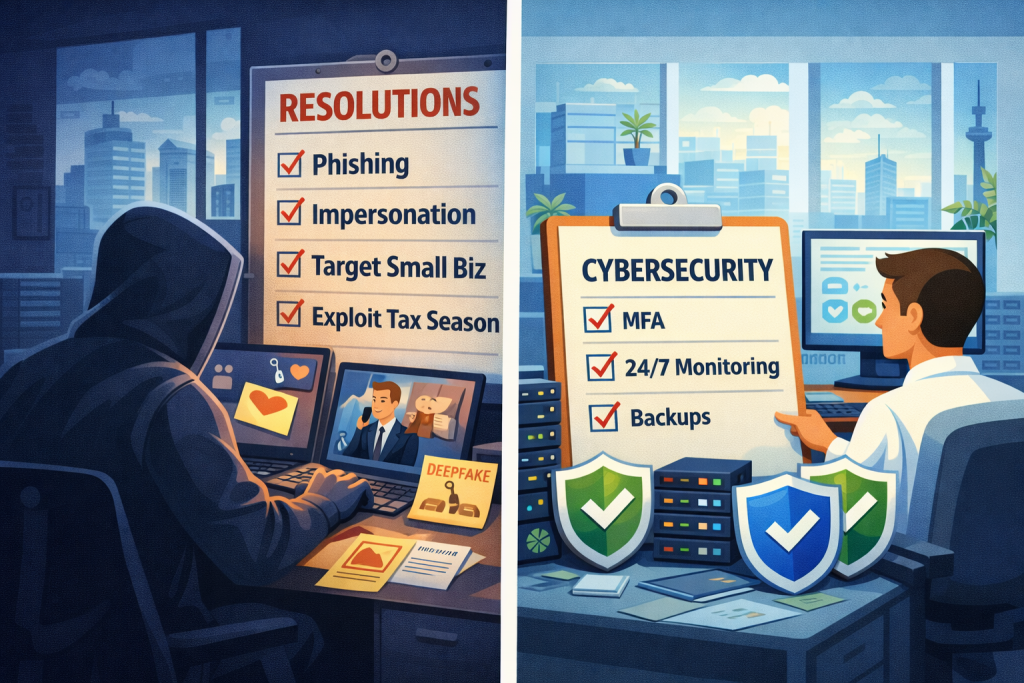
Somewhere right now, a cybercriminal is setting New Year’s resolutions.
They’re not journaling about mindfulness or cutting carbs.
They’re reviewing what worked last year—and planning how to steal more in 2026.
And small businesses? Still their favourite target.
Not because you’re careless.
Because you’re busy.
And criminals love busy.
Here’s their 2026 game plan—and how to ruin it.
Resolution #1: “Send Phishing Emails That Don’t Look Fake”
The era of obvious scam emails is over.
AI now writes phishing messages that:
- Sound normal
- Match your company’s tone
- Reference real vendors
- Skip the red flags
Modern phishing doesn’t rely on typos.
It relies on timing.
January is perfect: inbox chaos, year-end cleanup, tax season ramp-up.
A real example:
“Hi [your name], the invoice bounced back. Can you confirm this is still the right email for accounting? I’ve attached the updated version. Thanks — [actual vendor name].”
No urgency. No drama. Just… plausible.
Your counter-move:
- Verify any request involving money or credentials through a second channel
- Use impersonation-detection email filtering
- Reward employees for questioning instead of responding quickly
Resolution #2: “Impersonate Vendors—or Your Boss”
Vendor fraud and executive impersonation are exploding.
“Hey, we updated our bank details.”
“Urgent—wire this now, I’m in a meeting.”
And now it’s not just email.
Deepfake voice scams are here. Criminals clone voices from podcasts, webinars, even voicemail greetings. The call sounds exactly like your partner or CEO.
That’s not sci-fi. That’s Tuesday.
Your counter-move:
- Mandatory callback verification for banking changes
- No payment changes without voice confirmation via known numbers
- MFA on all finance and admin accounts
Resolution #3: “Target Small Businesses Harder Than Ever”
Big companies got better at security.
Insurance got stricter.
Attacks got harder.
So criminals pivoted.
Why risk one $5M enterprise breach when you can run 100 smaller, easier attacks?
Small businesses have:
- Real money
- Valuable data
- No dedicated security team
And one dangerous belief:
“We’re too small to be a target.”
You’re not too small.
You’re just too small to make the news.
Your counter-move:
- Implement basics that make you harder than the firm next door
- Stop thinking “unlikely” means “safe”
- Get professional monitoring—not enterprise complexity
Resolution #4: “Exploit New Hires and Tax Chaos”
January brings new employees.
They want to help.
They don’t know the rules yet.
They’re unlikely to question authority.
Perfect targets.
Add tax-season scams—tax form requests, payroll phishing, fake CRA notices—and the damage escalates fast.
Once tax forms are stolen, employees find out when their tax returns are rejected as “already filed.”
Your counter-move:
- Security training during onboarding
- Clear written rules: “We never send T4’s by email”
- Praise verification—never punish it
Prevention Beats Recovery. Every Time.
You have two options:
Option A: React after the breach
Ransom payments. Emergency IT. Client notifications. Reputational damage.
Cost: six figures.
Timeline: weeks or months.
Option B: Prevent it quietly
Security controls. Training. Monitoring. Testing.
Cost: a fraction.
Outcome: nothing happens—and that’s the goal.
You don’t buy a fire extinguisher after the fire.
How to Ruin a Cybercriminal’s Year
A good IT partner keeps you off the “easy target” list by:
- Monitoring systems 24/7
- Enforcing MFA and access controls
- Training teams on modern scams
- Verifying payment changes
- Testing backups regularly
- Patching before criminals exploit gaps
Fire prevention. Not firefighting.
Criminals are optimistic about 2026.
They’re counting on businesses being busy, distracted, and under-protected.
Let’s disappoint them.
Take Your Business Off Their List
Book a New Year Security Reality Check.
We’ll show you where you’re exposed, what matters most, and how to stop being low-hanging fruit in 2026.
No scare tactics. No jargon. Just clarity.
[Book your 15-minute New Year Security Reality Check]
Because the best New Year’s resolution
is making sure you’re not on someone else’s.

