 Funny until you think about what your office actually runs on
Remember when IT support meant blowing into a Nintendo cartridge and hoping for the best?
That was the process.
Game would not load? Blow on it.
Still not working? Blow harder.
Still nothing? Give the console a light smack and act like you were an engineer.
That was a simpler time.
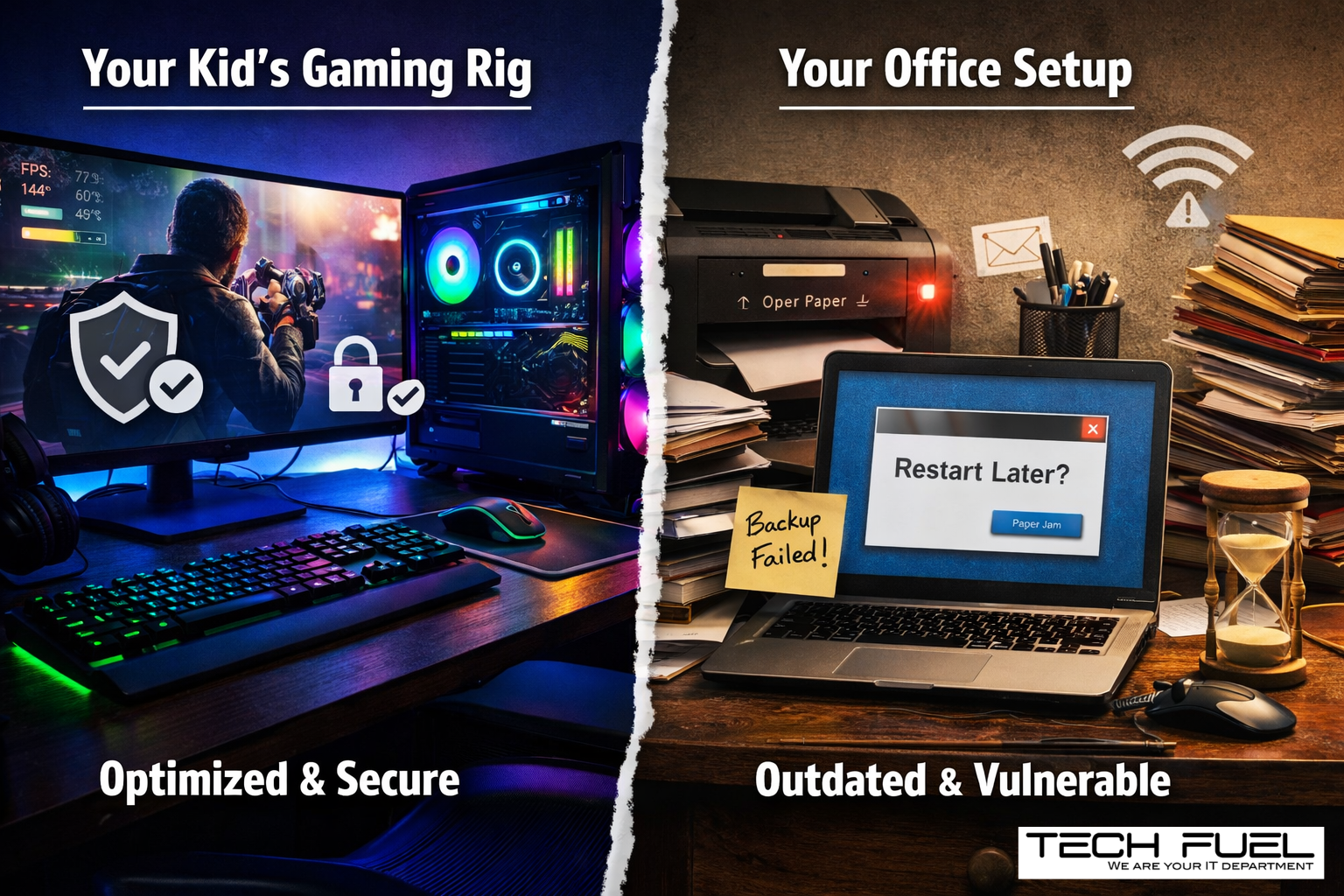
Now fast-forward to your kid’s bedroom. Their gaming setup has a solid-state drive, enough RAM to launch a small spacecraft, mesh Wi-Fi, real-time performance monitoring, automatic updates, and multi-factor authentication on every account worth protecting.
It is tuned. Optimized. Maintained.
Now think about your office.
There is probably a laptop from 2019 taking its sweet time to boot up. A printer with a long-standing personal vendetta against Tuesdays. Shared folders named things like “Final,” “Final 2,” and the always-comforting “Final FINAL Use This One.” Software that sort of talks to each other if the moon is in the right phase. Wi-Fi that mysteriously weakens the moment someone walks into the boardroom. And at least one machine that has been asking to restart for updates since the Leafs still had people feeling optimistic.
Gamers optimize.
Businesses tolerate.
And for accounting firms, that gap is not just annoying. It is expensive.
Why This Comparison Is More Accurate Than Most Firm Owners Want It to Be
This is not really about money.
A solid gaming rig is not wildly more expensive than a decent business workstation. Business internet is often faster than what people have at home. Monitoring tools, security controls, backups, and modern cloud systems are not some exotic luxury reserved for Bay Street giants.
The real difference is attention.
Gamers care deeply about performance. They notice lag. They hate downtime. They update things before problems start. They monitor every moving part like it is a Formula One car.
Most businesses, meanwhile, get used to a low hum of technological frustration and start calling it normal.
That is where things go sideways.
Gamers patch immediately. Businesses postpone.
Your kid updates drivers, firmware, software, and game patches the minute they drop. Not because anyone made them. Because they know outdated software means poor performance, glitches, or vulnerability.
In their world, lag is unacceptable.
In a lot of offices, updates get postponed because someone is busy, something might break, or the restart prompt has become part of the décor.
But every delayed patch is not just an inconvenience. It is a known issue someone already found and fixed. You just have not installed the fix yet.
That is a risky habit in any business. In an accounting firm handling tax files, payroll records, financial data, and confidential client information, it is worse.
Gamers protect their data. Businesses often assume it is fine.
A gamer loses one important save file and becomes a backup evangelist overnight.
Meanwhile, many businesses still do not know whether their backups actually ran last week, whether they are restorable, or how quickly they could recover if something went wrong.
That is not a minor detail. That is the difference between a bad afternoon and a serious operational problem.
In a gaming setup, lost data means lost progress.
In an accounting firm, lost data can mean missed deadlines, client disruption, reputational damage, and a very unpleasant conversation you did not plan to have.
Gamers monitor performance in real time. Businesses wait for complaints.
Gamers watch CPU temperatures, frame rates, latency, bandwidth, storage, and performance dips constantly. If something feels even slightly off, they start troubleshooting.
Most businesses discover there is a problem when someone says, “The internet seems slow today.”
That is not monitoring. That is a group chat with lower standards.
And your office network, unlike a gaming setup, is actually tied to billable work, deadlines, client service, and revenue.
So yes, the comparison is a bit ridiculous.
It is also uncomfortably accurate.
How Offices End Up This Way
No one sits down and says, “Let’s build a clunky, fragile, mildly irritating technology environment and then rely on it for everything.”
It happens gradually.
A new tool gets added to solve one problem. Then another platform gets brought in for document management. Then something for CRM. Then payroll. Then client communication. Then a workflow tool. Then a security add-on. Then an app somebody swears is essential but no one fully understands.
None of those decisions are necessarily wrong on their own.
The problem is that over time, technology stops being designed and starts being accumulated.
And accumulation creates friction.
That is especially true in accounting firms, where systems are often layered over years of growth, changing services, staffing shifts, compliance pressure, and “we needed something quickly” decisions made in the middle of tax season.
Before long, you do not have a tech stack.
You have a technology junk drawer.
Gaming setups are built intentionally for performance. Most office environments are built reactively for convenience.
One is a strategy. The other is a collection.
Collections get messy.
The Cost No One Really Calculates
The danger is not always a dramatic outage.
Usually, it is the slow leak.
A few extra minutes waiting for a machine to start. Time lost searching for a file. Data entered twice because two systems do not sync properly. Staff working around a clunky process because “that is just how we do it here.” A reboot here. A login delay there. A printer tantrum for flavour.
Each one feels minor.
Together, they become a tax on the business.
And accounting firms already pay enough tax.
That is the trick with bad technology. It rarely announces itself as a crisis. It hides inside small delays that everyone has normalized.
But “normal” is one of the most expensive words in business technology.
Because once your team adapts to inefficiency, the problem disappears from the budget conversation while still quietly draining time, focus, and margin.
For firms trying to grow advisory services, improve client responsiveness, or simply get through busy periods without everything feeling harder than it should, that matters.
A lot.
The Better Question for Firm Owners
When you ask most business owners about their tech, the answer is usually some version of:
“It works fine.”
Fair enough. But “working” is a low bar.
A better question is whether it is working well.
Are your systems integrated or just awkwardly coexisting?
Are your workflows streamlined or stitched together with workarounds?
Are your tools helping your team move faster, or just giving them new places to click?
Is anyone paying attention to performance, security, and stability before something breaks?
That is the real conversation.
Because modern business performance is not driven by hardware alone. It comes from the whole environment — systems, software, automation, security, support, and process design all working together.
Or not.
A Quick Self-Test
Here are four questions worth asking:
Do you know when your oldest office computer was purchased?
Do you know whether your backups completed successfully last week?
Is there a device on your network right now with a pending update that has been ignored for more than a week?
Could you tell someone your office internet speed without looking it up?
Your kid could probably answer all four of those questions about their gaming setup in under ten seconds.
If you cannot answer them about the systems your firm depends on every day, that is not a personal failure.
It just means no one is really watching the whole picture.
And that is a fixable problem.
Where Tech Fuel Comes In
We help accounting firms move from tolerated tech to intentional tech.
That means stepping back and looking at the whole environment: what is outdated, what is redundant, what is slowing your team down, what is creating avoidable risk, and what could be simplified, secured, or automated.
The goal is not more technology.
It is better technology. Smarter technology. Technology that actually supports how your firm wants to operate and grow.
If you want to review whether your systems, software, and workflows are helping your productivity and profitability — or quietly working against both — that is exactly the kind of conversation we like having.
No jargon. No pressure. No requirement to know what your Wi-Fi speed is before we talk.
[Book your 10-minute discovery call]
And if this made you think of another firm owner who has been putting up with more lag than they should, pass it along.
In business, just like in gaming, performance matters.