Not all compliance failures start with a breach.
But most of them start with an assumption.
“We have MFA.”
“Our backups are covered.”
“Our staff know what to do.”
“Our IT provider handles that.”
Lovely.
But when a client asks for proof, an insurer wants evidence, or a cyber incident forces everyone to look under the hood, assumptions suddenly become expensive.
For accounting firms, compliance is not a checkbox exercise. You are handling tax files, payroll records, SINs, banking details, estate documents, corporate financials, and confidential client information every day.
That means your firm does not just need security tools.
It needs proof that those tools are working, documented, monitored, and aligned with how the firm operates today.
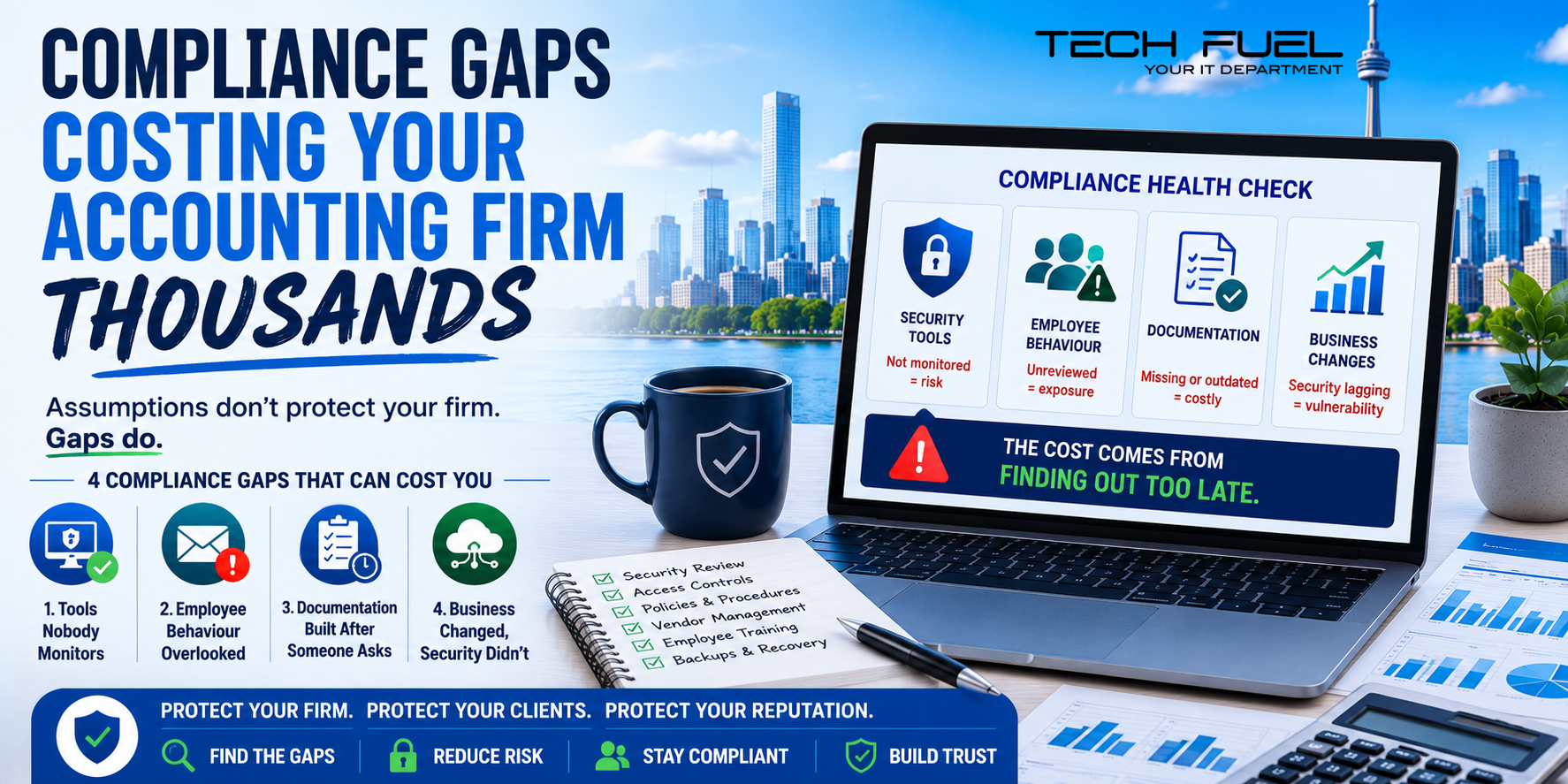
Here are four compliance gaps that can cost firms thousands when left unchecked.
Gap #1: Security Tools Nobody Is Watching
Most firms already pay for security tools.
Endpoint protection. MFA. Firewalls. Email filtering. Threat detection. Backup software. Device encryption.
On paper, that looks comforting.
A nice little security buffet.
But the real question is not whether the tools exist.
The real question is: who is managing them?
Who confirms MFA is enforced across every account?
Who checks endpoint protection is installed on every laptop?
Who reviews suspicious login alerts?
Who catches failed updates?
Who verifies former employees no longer have access?
Who responds when something suspicious is flagged?
Security tools are not magic. They do not protect devices they cannot see. They do not respond to alerts nobody reads. They do not fix bad configurations simply because the monthly invoice is paid.
Buying the tool is step one.
Protection comes from managing, monitoring, and maintaining it.
That distinction matters during audits, insurance renewals, client reviews, and incidents.
A checkbox answer gets noticed.
Proof earns trust.
Gap #2: Employee Behaviour Nobody Has Revisited
Your staff are not trying to create risk.
They are trying to get work done.
That is why compliance problems often sneak in through ordinary behaviour.
A file gets emailed instead of uploaded securely. A password gets reused. A staff member approves a fake invoice. Someone accesses client files from a personal device after hours. A seasonal worker gets more permissions than they need because tax season is moving fast.
None of this usually starts with bad intent.
It starts with pressure.
Staff need clear expectations, practical training, and systems that make safe behaviour easy.
Secure file-sharing. Enforced MFA. Role-based access. Regular phishing training. Simple escalation steps.
Compliance is not just written in policies.
It is lived through habits.
Gap #3: Documentation Built After Someone Asks For It
You may be doing many things right.
But if the evidence is scattered, outdated, or sitting in someone’s inbox from last year, you still have a problem.
When someone asks for proof, the clock starts.
A client wants to know how data is protected. An insurer asks for MFA evidence. A partner asks for an incident response plan. A vendor questionnaire lands on your desk.
That is the wrong time to start building documentation.
Scrambling creates mistakes. It also makes your firm look less prepared than it may be.
Strong compliance means evidence is ready before the question arrives.
Policies are reviewed. Access records are maintained. Vendor checks are tracked. Backup tests are documented. Incident plans are written before incidents happen.
In compliance, “we do that” is not as strong as “here is the record showing we do that.”
Gap #4: The Firm Changed, But Security Stayed Behind
Your firm may have changed more this year than your security has.
Maybe you hired staff, added seasonal workers, expanded remote work, adopted new cloud tools, connected new apps, changed vendors, or took on clients with stricter requirements.
Each change affects security and compliance.
A setup built for 10 people may not work for 25. A backup plan built around old servers may not cover new cloud platforms. Access rules that made sense last year may be too loose now.
That is how firms outgrow their protection.
Quietly.
One new app, one new person, one new workaround at a time.
Finding Gaps Late Is What Gets Expensive.
Compliance gaps become costly when firms discover them under pressure.
After a client asks.
After an insurer requests evidence.
After a staff mistake.
After a cyber incident.
The smarter move is to find them first.
At Tech Fuel, we help accounting firms identify gaps hiding between tools, people, vendors, policies, and day-to-day operations.
Because your firm does not need vague security promises.
It needs clear controls, clean documentation, monitored tools, and systems that protect client trust.
Call us at 1-855-737-8277, book a quick Discovery Call, or view our I.T. Buyers Guide.