 Because if every Monday starts with a printer problem, that’s not “just IT”
It’s Monday morning.
You’ve got coffee. You’ve got a plan. You’ve even convinced yourself this might be the week you finally get ahead.
Then you walk into the office.
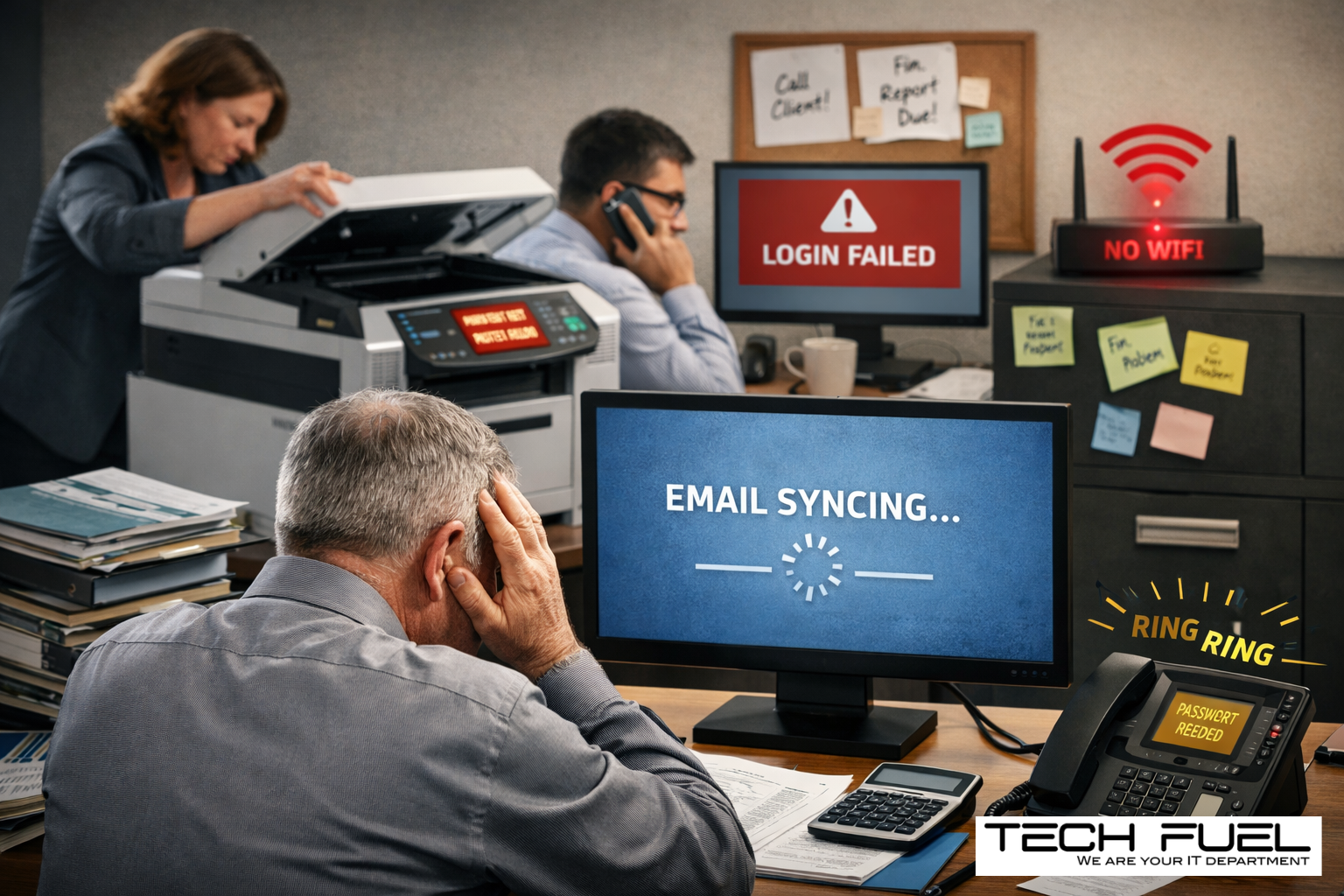
Before your bag hits the floor, someone says, “The printer’s down again.”
Not the old printer. The new one. The one that was supposed to end the printer drama and usher in a brighter future.
You suggest restarting it, because that is the universal business-owner IT move. Your office manager has already done that. Twice. You both know this is now a ritual, not a solution.
By 8:40, someone can’t get into the firm’s accounting software.
By 9:05, a team member is locked out of email because the two-factor code is still going to an old phone number from three upgrades ago.
By 9:20, the Wi-Fi in the back office drops for reasons no one can explain but everyone has learned to resent.
By 9:30, someone is asking whether the scanner is working, a client is waiting on a reply, and Outlook is still “syncing” like it has all the time in the world.
And just like that, the morning is gone.
You have not advised a client. You have not reviewed a file. You have not moved the business forward.
You have simply been drafted into unpaid technical support.
Sound familiar?
The Part No One Mentions When You Start a Firm
Most accounting firm owners started their business because they were good at the actual work.
Tax planning. Bookkeeping. Assurance. Compliance. Advisory. Client relationships. Building something solid.
What no one tells you is that somewhere along the way, you also become the person expected to weigh in on Wi-Fi issues, software logins, printer tantrums, and whether the team should “just try restarting it again.”
No one hands you a job description that says:
Managing Partner, CPA, and Occasional Troubleshooter of Random Office Technology
And yet, here we are.
That is how it happens in a lot of firms. Technology gets added one piece at a time, and somehow the person leading the business ends up carrying the stress of whether all of it works.
Not because they want to. Because nobody else really owns it.
It’s Not Just Wrecking Your Morning. It’s Wrecking Everyone Else’s Too.
Here is the part that gets missed.
That printer issue is not just a printer issue.
That login problem is not just one person’s annoyance.
That Wi-Fi drop is not just bad luck.
It is friction. Repeated, costly friction.
Your admin team loses time. Your accountants lose momentum. A manager gets pulled into solving something they should never have to touch. Someone misses a callback. Someone delays sending a file. Someone creates a workaround because the system is unreliable, and now the workaround becomes the process.
Nobody tracks those minutes carefully, but everyone feels them.
And in accounting firms, where deadlines stack fast and client expectations do not exactly relax when your systems are having a moment, that friction compounds quickly.
It becomes the background hum of the firm.
A low-grade, daily aggravation that people stop questioning because “that’s just how it is here.”
That phrase should make every firm owner itchy.
Because “that’s just how it is” is how operational drag hides in plain sight.
The Most Expensive Problems Are Usually the Least Dramatic
Most firms do not suffer a giant, cinematic technology failure.
They suffer the slow leak.
Logins that take too long.
Software that does not sync cleanly.
Email that lags.
File storage that feels like a scavenger hunt.
Internet that mostly works.
Tools that technically function, but make everything take longer than it should.
Individually, none of these are headline-worthy.
Collectively, they are expensive.
If eight people in your firm lose 15 or 20 minutes a day to avoidable tech friction, that is not a minor annoyance. That is hundreds of lost hours over the course of a year.
And those hours are not just disappearing from admin time. They are coming out of productive time, billable time, client-response time, and the mental energy your team should be using for work that actually matters.
That is what makes poor technology support so sneaky.
It does not always break the business.
It just quietly slows it down.
What Firm Owners Actually Want
Let’s be honest.
You do not wake up wishing for a more exciting firewall conversation.
You do not want a lecture about infrastructure. You do not want a dramatic pitch about cloud transformation. You do not want another vendor throwing jargon at you and calling it strategy.
You want the systems to work.
You want the printer to print.
You want the Wi-Fi to stay up.
You want your accounting software, document management, email, and client tools to do their jobs quietly.
You want your team going to someone else when tech acts up.
You want problems handled before they become interruptions.
Most of all, you want Monday morning to belong to the business you actually run — not the collection of digital gremlins currently squatting in it.
That is not asking for luxury.
That is asking for baseline competence.
Why It Stays This Way for So Long
Usually, because nothing is completely broken.
You can still print. Eventually.
You can still log in. Usually.
You can still send the email. More or less.
You can still work around the issue. Again.
So nothing feels urgent enough to force a bigger conversation.
That is why firms tolerate bad tech far longer than they should. Not because the leadership is careless. Because the problems are just survivable enough to be ignored.
And because, over time, your technology likely was not designed as one coherent environment.
It was assembled.
A tool got added when the firm needed it.
Another platform came in to solve another issue.
Someone set up the Wi-Fi ages ago.
A new printer replaced a dead one.
Another app got layered on because the old process was clunky.
A workaround became permanent.
A temporary fix turned into policy by accident.
Each decision made sense at the time.
But accumulated technology and designed technology are not the same thing.
One keeps the lights on.
The other helps the firm move forward.
What Actually Helps
Not another generic assessment dressed up as a sales funnel.
What helps is someone looking at the whole picture.
The hardware.
The software.
The workflows.
The logins.
The integrations.
The weak points.
The little frustrations your team deals with every day and has stopped mentioning because they assume no one can fix them.
That is not just an IT conversation.
It is an operations conversation.
Because when technology is slowing down your people, interrupting your mornings, and forcing your team into workarounds, the issue is not technical in the narrow sense. It is operational. It is affecting how the firm functions.
And that is worth paying attention to.
A Quick Gut Check
A few honest questions:
Do your mornings regularly begin with small tech fires?
Have your staff built workarounds for things that should just work?
Has anyone reviewed your full tech environment in the past year — not just antivirus, but the way your systems, workflows, and tools actually support the firm?
If the answer is yes, yes, and no, then your technology may not be helping your business nearly as much as you think.
It may just be helping you cope.
There is a difference.
Let’s Make Monday Morning Boring Again
Technology should be quiet.
You should be walking into the office thinking about clients, deadlines, staff, revenue, growth, and the bigger picture — not routers, printers, password resets, and whether Outlook plans to cooperate today.
Maybe this is still your Monday morning.
Maybe it used to be, and you are very glad those days are behind you.
Or maybe you are reading this and thinking of another firm owner who is still spending too much of their week playing reluctant IT manager.
Wherever you are in that picture, the point is the same:
You did not build this business to spend your best hours babysitting bad systems.
You built it to do work you are actually great at.
Your technology should make that easier.
Not harder.
Where Tech Fuel Comes In
We help accounting firms get out of survival mode with technology.
That means stepping back and looking at how your systems actually support the day-to-day running of the firm — where the friction is, what is outdated, what is clunky, what is creating avoidable interruptions, and what could be simplified so your people can get on with the real work.
No drama. No jargon. No “free assessment” nonsense that somehow ends in a three-page hardware quote you did not ask for.
Just a practical conversation about whether your tech is helping the firm run smoothly or quietly making every week harder than it needs to be.
[Book your 10-minute discovery call]
And if this sounds less like your business now and more like someone you know, send it to them.
They are probably too busy restarting the printer to ask for help themselves.