
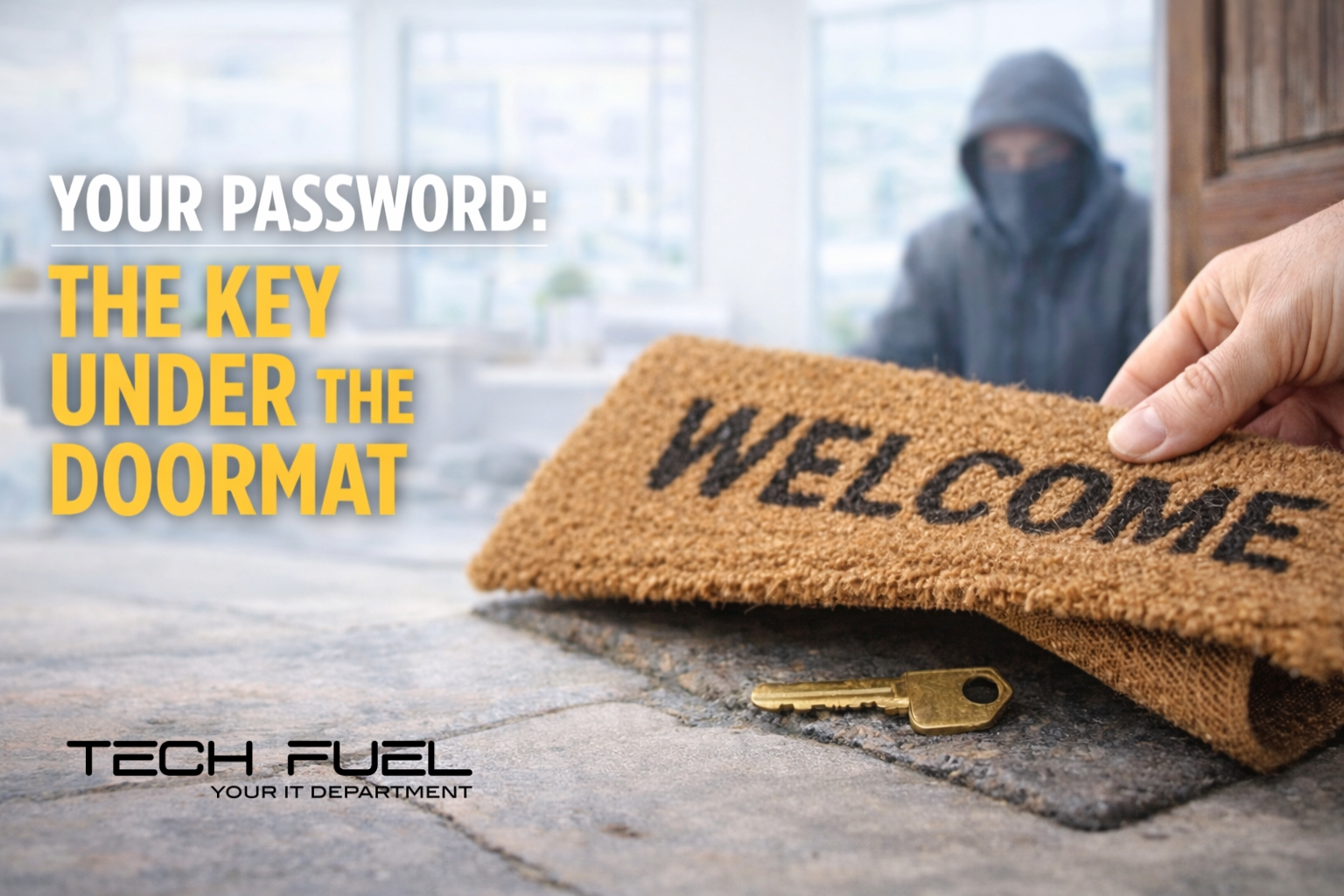
Walk up to a house. Lift the welcome mat. There’s the key.
Convenient? Sure.
Smart? Not even a little.
That’s how a lot of firms still handle passwords. Not on purpose, of course. But when the same password gets reused across email, tax software, cloud apps, and client portals, that’s exactly what’s happening: the key is sitting in the most obvious place possible.
And in an accounting firm, where trust is everything and sensitive data is the business, that’s a dangerous game.
The Real Problem Usually Starts Somewhere Else
Most password-related breaches do not start with your firm being directly targeted.
They start when some completely unrelated site gets hacked. A retail account. A food delivery app. An old software subscription someone signed up for three years ago and forgot existed.
That breach exposes an email address and password. Then the attackers do what attackers always do: they stop being creative and start being efficient.
They take those same login details and try them everywhere else.
Your Microsoft 365 account.
Your bookkeeping software.
Your cloud storage.
Your banking portal.
Your client-facing apps.
That is how one weak habit turns into a full-blown business risk.
For an accounting firm, it is not just an inconvenience. It is a direct route to client data, financial records, internal emails, and the kind of mess that shows up at exactly the wrong time — usually when you are already buried in deadlines.
One Reused Password Can Open Every Door
Think of it like this.
Imagine carrying one key that opens your house, your office, your car, your file cabinets, and every room inside your building.
Now imagine losing it.
That is what password reuse does. It turns one stolen login into a master key.
And here’s the part that should make every firm owner pause: this is not rare. It is normal. People reuse passwords because they are busy, overloaded, and trying to get through the day without needing a spreadsheet just to log in.
That does not make them careless. It makes them human.
The problem is that cybercriminals count on exactly that.
Credential Stuffing: The Attack Nobody Notices Until It’s Too Late
There is a name for this kind of attack: credential stuffing.
It sounds technical. It is not.
It simply means attackers take stolen usernames and passwords and run them through automated tools that test those credentials across hundreds of websites and systems. Fast. Quietly. At scale.
No genius hacker in a dark room. No movie scene. Just software doing boring, relentless work while your team is asleep.
By the time someone notices unusual activity, the damage may already be done.
That is why security does not usually fail because a password is too simple.
It fails because the same password was used in too many places.
A strong password protects one account.
A unique password protects the business.
“But Our Passwords Are Strong”
This is where a lot of firms get a false sense of comfort.
A password with a capital letter, a number, and a symbol used to sound impressive. For a long time, that was the advice. So people followed it.
Now you end up with things like:
Summer2024!
LeafsFan1!
TaxSeason#1
They look stronger. They feel stronger. They are not nearly as strong as people think.
Modern attacks are automated. They are fast. And they are built to test common patterns first, because human beings are predictable. We add years. We add punctuation. We use sports teams. We swap an “o” for a zero and feel clever.
Attackers have seen that movie before.
Longer passwords are better than clever-looking ones. Unique passwords are better than memorable repeats. And passwords alone are no longer enough.
That is the real point.
Passwords Alone Are a 2006 Security Strategy
Even a great password has limits.
One phishing email can capture it.
One vendor breach can expose it.
One sticky note on a monitor can cancel out all the effort that went into creating it.
So no, the answer is not to make everyone in your firm invent even more ridiculous passwords they will immediately forget.
The answer is to build a better system.
The Two Fixes That Solve Most of This
Good security should work with human behaviour, not against it.
That means assuming people will forget things, reuse things, and click things they should not. Because they will. They are busy. They are doing real work. They are not sitting around dreaming up perfect password hygiene.
Two simple changes close most of the gap.
- Use a password manager
A password manager creates and stores a different complex password for every account.
So the password for Microsoft 365 is different from the one for QuickBooks. Which is different from the one for CaseWare. Which is different from the one for your client portal.
That matters.
Because if one account gets exposed, the others are still protected.
Your team does not need to memorize 87 passwords. They just need one secure way to access the rest.
- Turn on multi-factor authentication
If your password is the lock, MFA is the deadbolt.
It adds a second step, usually through an authentication app or approval prompt on a phone. So even if someone gets the password, they still cannot get in without that second factor.
That one extra layer stops a huge number of account takeover attempts cold.
And no, this is not overkill for a small or mid-sized accounting firm in Toronto.
When you handle payroll records, tax files, financial statements, and confidential client information, this is basic professional hygiene.
The Goal Is Not Perfect People. It’s Smarter Systems.
This is the part many firms miss.
Security is not about finding a magical way to make everyone behave perfectly.
It is about building an environment where normal human mistakes do not turn into business disasters.
People will reuse passwords unless you give them a better tool.
People will delay updates unless the process is simple.
People will occasionally click the wrong thing.
Strong systems expect that and reduce the fallout.
Weak systems cross their fingers and hope for the best.
Hope is not much of a cybersecurity strategy.
For Accounting Firms, the Stakes Are Higher
In a lot of businesses, a compromised login is annoying.
In an accounting firm, it can mean exposure of financial records, confidential client documents, internal communications, and data that clients trusted you to protect without question.
That trust is hard won. And once it is cracked, it is expensive to repair.
Especially during tax season, year-end reporting, or an audit window, the last thing your team needs is to discover that a preventable password issue has turned into downtime, panic, and client damage control.
That is not just an IT issue.
That is an operations issue. A reputation issue. A leadership issue.
Don’t Leave the Key Under the Mat
Most breaches do not begin with brilliance.
They begin with an unlocked door.
A reused password.
An account without MFA.
A system built on good intentions instead of good controls.
Maybe your firm already has this sorted. Great. You are ahead of a lot of businesses.
But if even a few team members are still reusing passwords, sharing logins, or relying on a single layer of protection, this is worth fixing now — before it becomes an expensive lesson later.
Because the easiest breaches are the ones nobody thought would happen to them.
[Book your 10-minute discovery call]
And if someone on your team is still using the same password they set back when remote work first became a thing, now would be a very good time to retire it.